The Application Avalanche Is a Signal Problem, Not a Volume Problem
Not only are there statistically more applications per opening, almost every one of them is well polished.
For smaller hiring teams, three hundred "quality" applications is not a good thing. It is three hundred documents to open without a reliable way to tell which candidates understand the role, can support their claims, or even want this particular opportunity.
And 299 rejections have to be sent.
For a strong candidate, that same avalanche creates a different problem. Relevant experience that used to stand out, is now lost in the noise.
The volume is real. The signal, harder to distinguish.
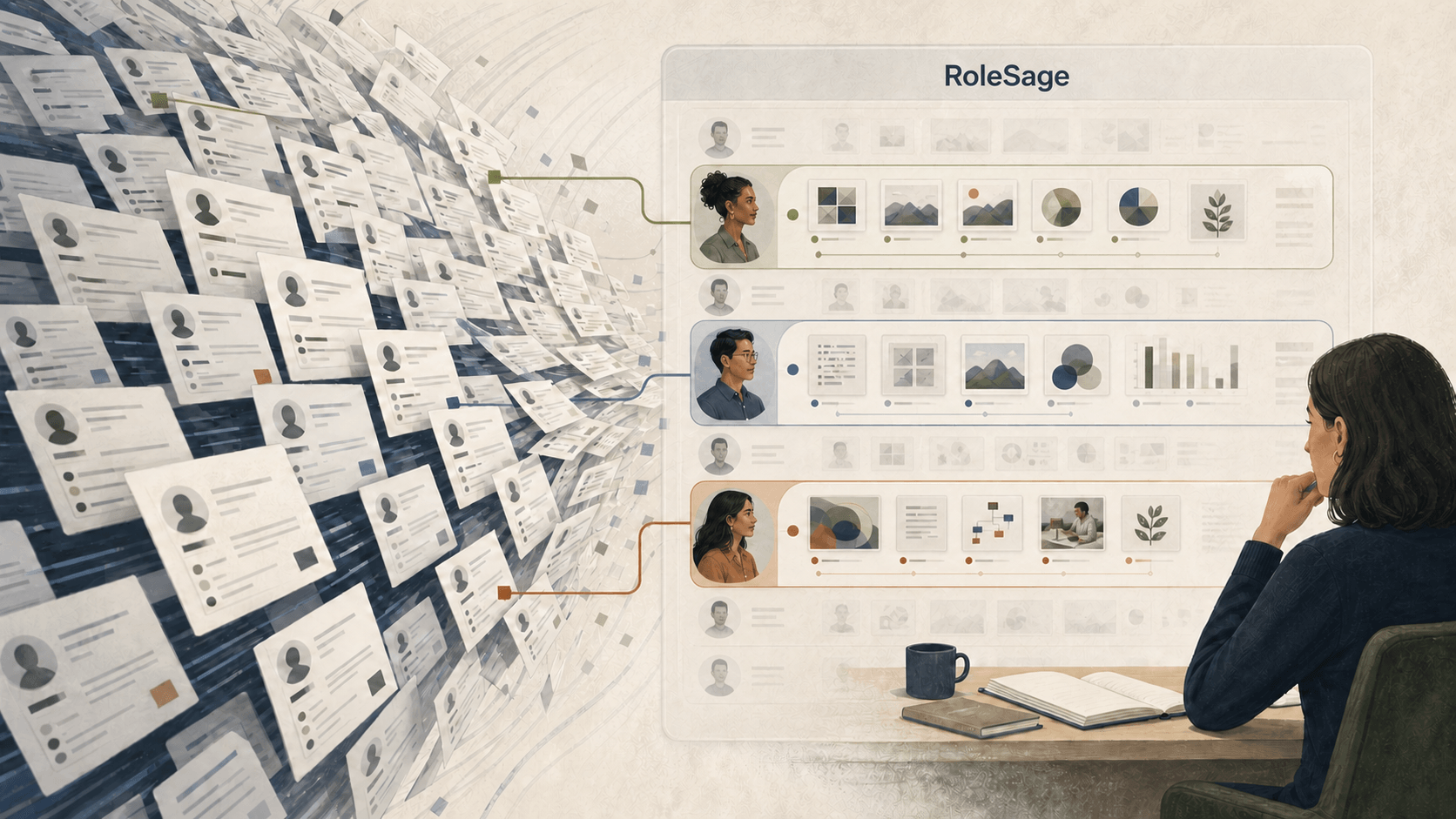
RoleSage helps hiring teams move beyond polished applications and compare the evidence behind each candidate, while people retain the hiring decision.
The scale has changed
Several large hiring-platform datasets now show how far the top of the funnel has expanded.
Greenhouse analysed more than 640 million applications across over 6,000 companies. Its 2026 benchmark reports that average applications per job rose from 116 in 2022 to 244 in 2025, while the average number of recruiters per organisation fell by 56%.[1]
Ashby analysed 109 million applications and 247,000 jobs from January 2021 to March 2026. It found that applications per hire tripled from 2021 to 2024 and remained above 300 throughout 2025.[2]
The datasets cover different customer populations and use different measures, so their figures should not be treated as one universal hiring benchmark. Together, they show the same operational shift: much more material is entering the funnel for each hiring outcome, often with fewer people available to review it.
Australia is experiencing the pressure too. SEEK reported that applications per job ad were 5.5% higher year on year in April 2026, from an already elevated level.[3]
None of those numbers tells a hirer which person can do the work.
More applications do not mean more qualified applicants
Application volume is growing for several reasons.
People apply more widely when job searches take longer and any single application has a low chance of receiving a response. AI helps candidates find roles, tailor resumes, improve wording, and prepare material faster. Automated tools can go further and submit applications at scale.
Employ's 2025 survey of more than 1,500 jobseekers found that 31% had used AI to support their search, while 66% reported job-search burnout.[4] Workable says around 10% of applications flowing through its platform now arrive through AI mass-apply tools.[5]
That does not make every AI-assisted application dishonest. Workable explicitly cautions that most people using mass-apply tools are real candidates with real resumes. A genuine candidate may use AI because writing is not the job, English is not their first language, or repeated applications have become a rational response to a difficult market.
The challenge is that thoughtful, generic, weak, and automated applications can now arrive looking unusually similar.
The old proxies are losing signal
Hiring teams have always used shortcuts when time is scarce. Many of those shortcuts are now even less dependable.
Polish is not proof
A fluent resume can contain strong, truthful examples. It can also make thin claims sound substantial. Presentation quality should not be mistaken for evidence of capability, interest, or fit.
Keywords are not context
A candidate can repeat the language in a job ad without showing where, when, or how they used a skill. Another candidate may describe highly relevant work in different industry language and be missed by a literal filter.
Submission effort is not intent
An easy application can come from an excellent candidate. A long application can be completed by automation.
What matters is not how much effort an application costs, but what that effort produces. Effort that is spent once, kept by the candidate, and reusable across every role is a different thing from effort that is re-spent on every application and discarded on rejection. The second kind tests who has spare time, not who can do the work and it falls hardest on candidates already working, caring for someone, or managing a disability.
A missing claim is not always a gap
No evidence found in a resume does not mean a person cannot do the work. It may mean the application is incomplete, the terminology differs, or the relevant example needs one focused question.
The answer is not to process weak proxies faster. It is to design the application around signals a person can inspect.
Better signal starts with the work
Before a role opens, define what would reduce uncertainty about each genuine requirement.
For example:
- Which candidate-provided activity or outcome would support the requirement?
- What related experience could credibly transfer?
- What must be present on day one, and what can be learned?
- Which practical conditions need to align?
- What should be verified in an interview, work sample, reference, or later conversation?
This creates a simple chain:
Role requirement → candidate-provided context → direct, related, missing, or unclear signal → human verification
A short application question can add one missing piece. It should not ask candidates to rewrite their resume, complete a large unpaid exercise, or prove everything before anyone speaks to them.
The companion article How Hiring Teams Can Reduce Application Avalanche covers the practical controls: clearer roles, better self-selection, proportionate questions, and disciplined triage. The deeper principle is that every control should improve the quality of information, not merely make applying harder.
How RoleSage helps restore hiring signal
RoleSage is built around the evidence layer between a job ad and a human decision.
Candidates can create an editable profile that connects skills to the activities, examples, and outcomes they provide. They control and strengthen their representation instead of being reduced to a static resume or surface polish.
Smaller hiring teams can structure role requirements, manage applicants in a light ATS workflow, and inspect what supports an application. RoleSage brings matched skills, related skills, activity evidence, application answers, alignment, gaps, and useful verification questions into the same review.
Match bands help organise attention, but they do not declare the best candidate. A reviewer can see why a signal appears direct, related, incomplete, or weak and decide what to explore next. RoleSage does not independently authenticate every candidate statement; it makes the candidate-provided context more specific, traceable, and useful for responsible verification.
There is some friction for candidates, as it does take time to flesh out a profile, to more fully tell their story, but this effort is re-usable for all future applications. AI reduces this burden by helping to organise and explain the information. Candidates remain responsible for what they provide. People remain responsible for the hiring decision.
That changes the operating question from:
How do we reject three hundred resumes faster?
to:
How do we find the applications with enough relevant context for a careful human review?
Count usable signal, not just applications
Raw application volume is easy to report. Add measures that show whether the hiring process is becoming more useful:
- the share of applications with assessable context for core requirements;
- time from opening the role to a credible shortlist;
- apparent gaps resolved by a focused question;
- screen-out reasons tied to genuine role requirements;
- response time for candidates who will not progress;
- strong candidates found through direct, related, or unconventional experience.
If applications fall while the team reaches a credible shortlist sooner and gives candidates clearer outcomes, the funnel may be healthier. If volume rises but usable context does not, reach has increased without improving hiring progress.
The goal is not the smallest applicant pool. It is a process where relevant work survives the noise, uncertainty is handled honestly, and both sides can see what should happen next.
See the person behind AI-polished applications. AI assists. People decide.
References and further reading
- Greenhouse: The Hire Standard - 2026 hiring benchmarks - platform analysis of more than 640 million applications across 6,000+ companies from 2022 to 2025.
- Ashby: Recruiter Productivity - 2026 Talent Trends Report - analysis of 109 million applications and 247,000 jobs from January 2021 to March 2026.
- SEEK Employment Dashboard, May 2026 - Australian job-ad and application-per-ad trends, including April 2026 application data.
- Employ: 2025 Job Seeker Nation Report findings - survey findings from more than 1,500 jobseekers on AI use, burnout, trust, and human connection.
- Workable: The Rise of AI-Assisted Job Applications - Workable platform observations on mass-apply tools and why AI assistance should not be treated as proof of a fake candidate.
- ERE: Drowning In and Drowned Out - The Application Volume Conundrum - TA practitioner analysis of rising volume, longer job searches, automated applications, and constrained recruiting teams.
- RoleSage: How Hiring Teams Can Reduce Application Avalanche - practical guidance on clearer roles, candidate self-selection, proportionate evidence requests, and disciplined triage.
- RoleSage: Why Candidate Fit Should Be Explained, Not Just Scored - why match signals should expose supporting context, gaps, limits, and next questions.